Comparative Guts

Search
Close this search box.

Comparative
Guts

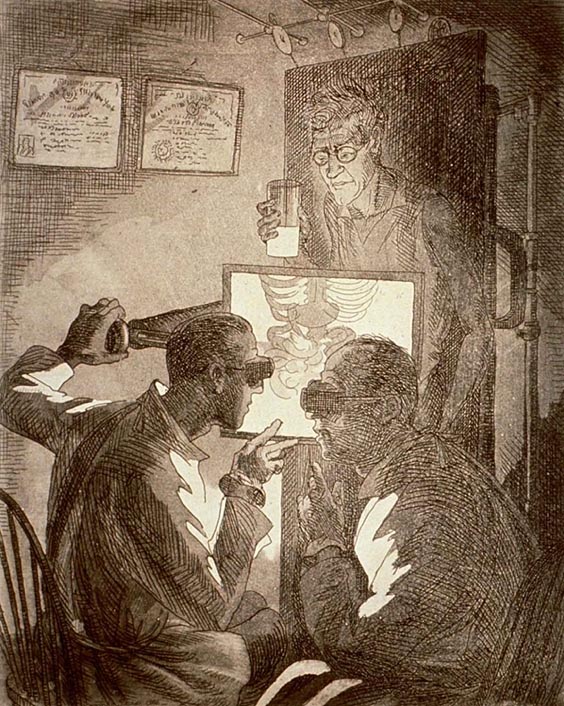
John Sloan, Ein Selbstportrait des Künstlers mit einem Bariumbecher in der Hand, der sich unter der Aufsicht von zwei Radiologen einer Durchleuchtung des oberen Magen-Darm-Trakts unterzieht — Bei diesem hochformatigen Druck in Grautönen aus dem Jahr 1926 handelt es sich um ein mit Radierung und Aquatinta geschaffenes Selbstporträt. Im Zentrum der Druckgrafik befindet sich der rechteckige Leuchtschirm. Vor einem weißen Hintergrund zeichnen sich darauf in Grau Rippen, der sackförmige Magen und daran anschließende Darmschlingen ab. Hinter dem Schirm steht ein schlanker Mann in Pullunder und Hemd. Sein längliches Gesicht mit dem markanten Kinn erscheint in einem helleren Grau als der Körper und die etwas vom Kopf abstehenden kurzen Haare. Der Mann trägt eine runde Brille. In seiner rechten Hand hält er ein durchsichtiges, zylindrisches Gefäß, das zu einem Drittel mit einer Flüssigkeit (Barium) gefüllt ist, die ebenso hell strahlt wie der Leuchtschirm. Der Mann steht zwischen dem Leuchtschirm und der türgroßen rechteckigen Platte. Sie erscheint nahezu schwarz und ist stark schraffiert. An der Wand, links neben dem Mann, hängen zwei gerahmte Urkunden. Aus der dunklen Platte ragt eine Stange heraus. An ihr ist im rechten Winkel an einem kurzen Arm, der Leuchtschirm befestigt. Am Kopf der Stange befindet sich ein Rad. Vor dem Leuchtschirm sitzen zwei Männer. Beide tragen Kittel, Schutzbrillen und helle Handschuhe. Der Mann links hat zurückgekämmtes dunkles Haar. Sein Blick ist auf den Schirm gerichtet. Mit der rechten Hand deutet er darauf, mit der linken umfasst er das Rad. Der Mann rechts hat Geheimratsecken und ebenfalls zurückgekämmtes dunkles Haar. Mit erhobenem linkem Zeigefinger sieht er zu seinem Kollegen. Die Partien der Kittel, die vom Leuchtschirm beschienen werden, strahlen weiß. Die Rückenpartien und die den Betrachtenden zugewandten Gesichtspartien der Männer sind in dunklen Grauabstufungen ausgeführt und stark schraffiert. Die Grauabstufungen lassen sich mit dem Aquatinta- Verfahren erzeugen, die Schraffuren mit der Radierung. —— John Sloan, A self-portrait of the artist holding a cup of barium and undergoing an upper gastrointestinal fluoroscopic study under the care of two radiologists — This portrait format print in shades of grey from 1926 is a self-portrait created with etching and aquatint. In the centre of the print is the rectangular illuminated screen. Against a white background, ribs, a sack-shaped stomach and adjoining intestinal loops stand out in grey. Behind the illuminated screen stands a slim man in a sweater and shirt. His elongated face with the prominent chin appears in a lighter grey than his body and short hair sticks out a little from his head. The man wears oval glasses. In his right hand, he holds a transparent cylindrical vessel, one-third of which is filled with a liquid (barium) that shines as brightly as the illuminated screen. The man stands between the illuminated screen and a door-sized rectangular plate. It appears almost black and is heavily hatched. On the wall, to the left of the man, are two framed documents. A pole protrudes from the dark panel. A lampshade is attached to it at a right angle on a short arm. At the head of the pole is a wheel. Two men are sitting in front of the illuminated screen. Both are wearing smocks, protective goggles, and light-coloured gloves. The man on the left has dark hair combed back. His gaze is directed at the screen. He points to it with his right hand and grips the wheel with his left. The man on the right also has dark hair combed back. With his left index finger raised, he looks at his colleague. Some parts of their gowns that are illuminated by the fluorescent screen shine white. Some other parts of the men's backs and faces, facing away from the fluorescent screen, are in dark shades of grey and are heavily hatched. The shades of grey are created using an aquatint technique and the hatching with an etching technique.
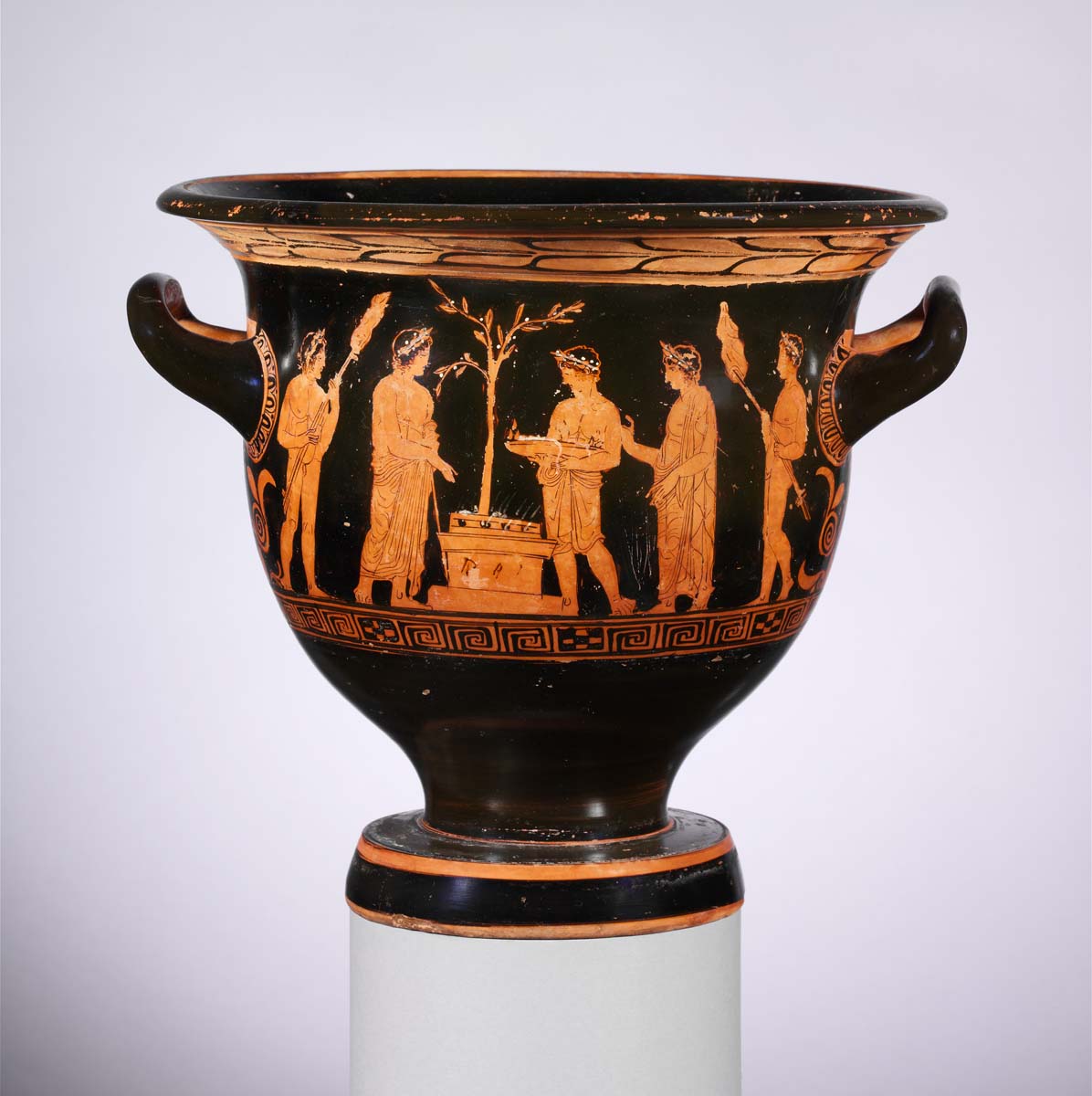
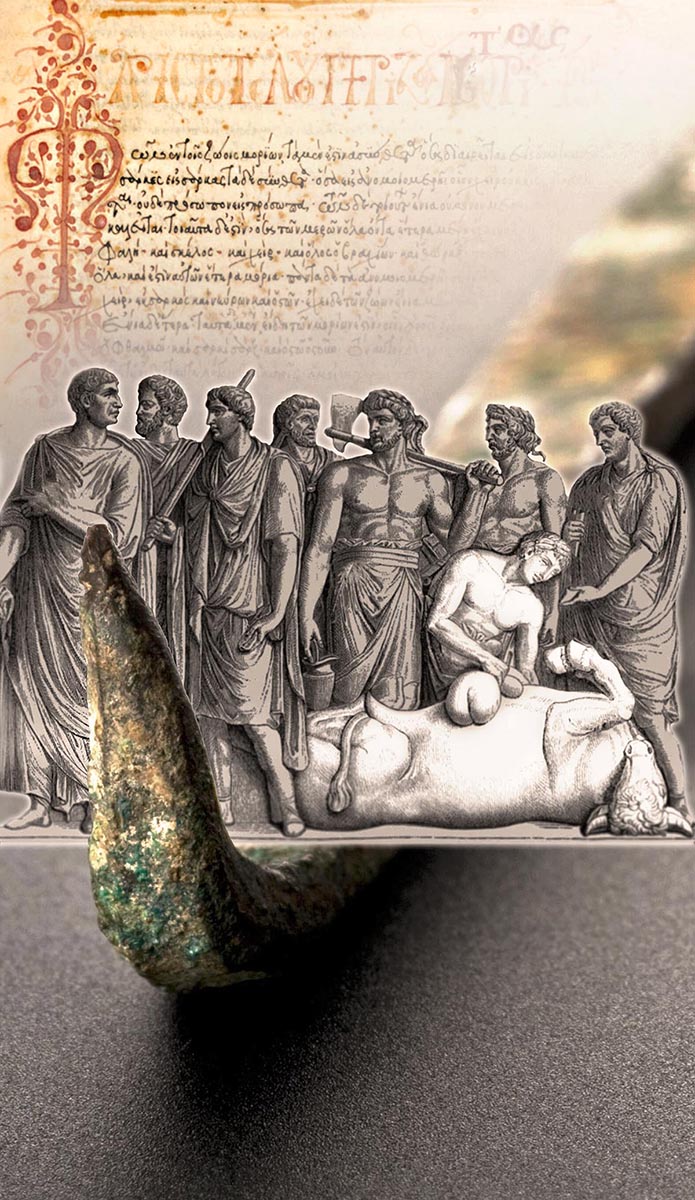
Rotfiguriger Terrakotta-Glockenkrater — Das Foto zeigt einen Ausschnitt eines oben offene glockenförmige Weinmisch-Gefäß aus Ton, der hat einen runden Fuß. Auf seinem schwarzen Korpus sind rötlich leuchtende Figuren dargestellt. Das Gefäß ist 32 Zentimeter hoch. Der bauchige Korpus steht auf dem kräftigen flachen Fuß. Er weitet sich nach oben und endet in einem auskragenden Rand. Sein Durchmesser beträgt 33 Zentimeter. Unterhalb der Auskragung sind zwei horizontale Henkel angebracht. Zwischen den Henkeln sind die Figuren platziert. Sie werden ober- und unterhalb der Szene von Ornamentbändern eingerahmt. Den Mittelpunkt der Szene bildet ein niedriger Altar. Er reicht bis zu den Knien der Figuren, die um ihn gruppiert sind. Auf dem Altar sind Holzscheite säuberlich aufgeschichtet. An den Scheiten verlaufen kurze weiße Striche schräg nach rechts oben. Sie könnten ein Feuer oder Bratengeruch andeuten. Hinter dem Altar befindet sich ein schlanker Baum mit wenigen länglichen Blättern. Um den Altar stehen drei barfüßige Männer, einer links und zwei rechts. Der Mann links ist mit einem locker um die Hüften geschlungenen Tuch bekleidet. Auf seinem dunklen lockigen Haar trägt er, wie die anderen Männer auch, einen Kranz. In der linken Hand hält er einen Stab, mit der rechten weist er zum Altar. Ihm gegenüber, rechts neben dem Altar, steht ein Mann mit einer Schale in den Händen. Auf der Schale liegt etwas Weißes. Auch er trägt ein lockeres Gewand um die Hüften. Rechts neben diesem Mann befindet sich ein weiterer. Dieser trägt ein fließendes Gewand, das bis zu den Knöcheln reicht und eine Schulter bedeckt. Zwei unbekleidete, ebenfalls barfüßige Männer mit Kränzen im Haar flankieren die drei. Sie tragen lange Spieße, um deren obere Enden vermutlich Eingeweide geschlungen sind. Diese Vase stammt aus dem späten 5. Jahrhundert v. Chr. Sie ist im Besitz des Metropolitan Museum of Art in New York, USA. —— Red-figure Terracotta Bell Krater — The open-topped, bell-shaped terracotta vessel with handles, is a wine-mixing vessel that has a round foot and is 32 centimetres high. The round-bodied vessel rests on a thick and flat base. It widens towards the top and ends in a projecting rim. Its diameter is 33 centimetres. Below the rim are two horizontal handles. On the black surface of the vessel, there is a scene with vibrant reddish figures depicted. The figures are placed between the handles. They are framed above and below the scene by ornamental bands. A low altar forms the centre of the scene. It reaches the knees of the figures grouped around it. Logs are neatly piled up on the altar. On the logs, short white lines run diagonally upwards to the right. They could convey a fire or the smell of roasting. Behind the altar is a slender tree with a few elongated leaves. Around the altar are three barefoot men, one on the left and two on the right. All three wear wreathes in their dark curly hair. The man on the left is dressed in a shawl loosely wrapped around his hips. In his left hand, he holds a staff and with his right, he points to the altar. Opposite him, to the right of the altar, stands a man with a bowl in his hands. On the bowl is something white. He too wears a loose robe around his hips. To the right of this second man is another. This one wears a flowing robe that reaches down to his ankles and covers one shoulder. Additionally, flanking the three men are two unclothed men who are also barefoot with wreaths in their hair. They carry long skewers, around the upper ends of which are probably entrails. This vase dates from the late 5th century B.C. It is in the possession of the Metropolitan Museum of Art in New York, USA.
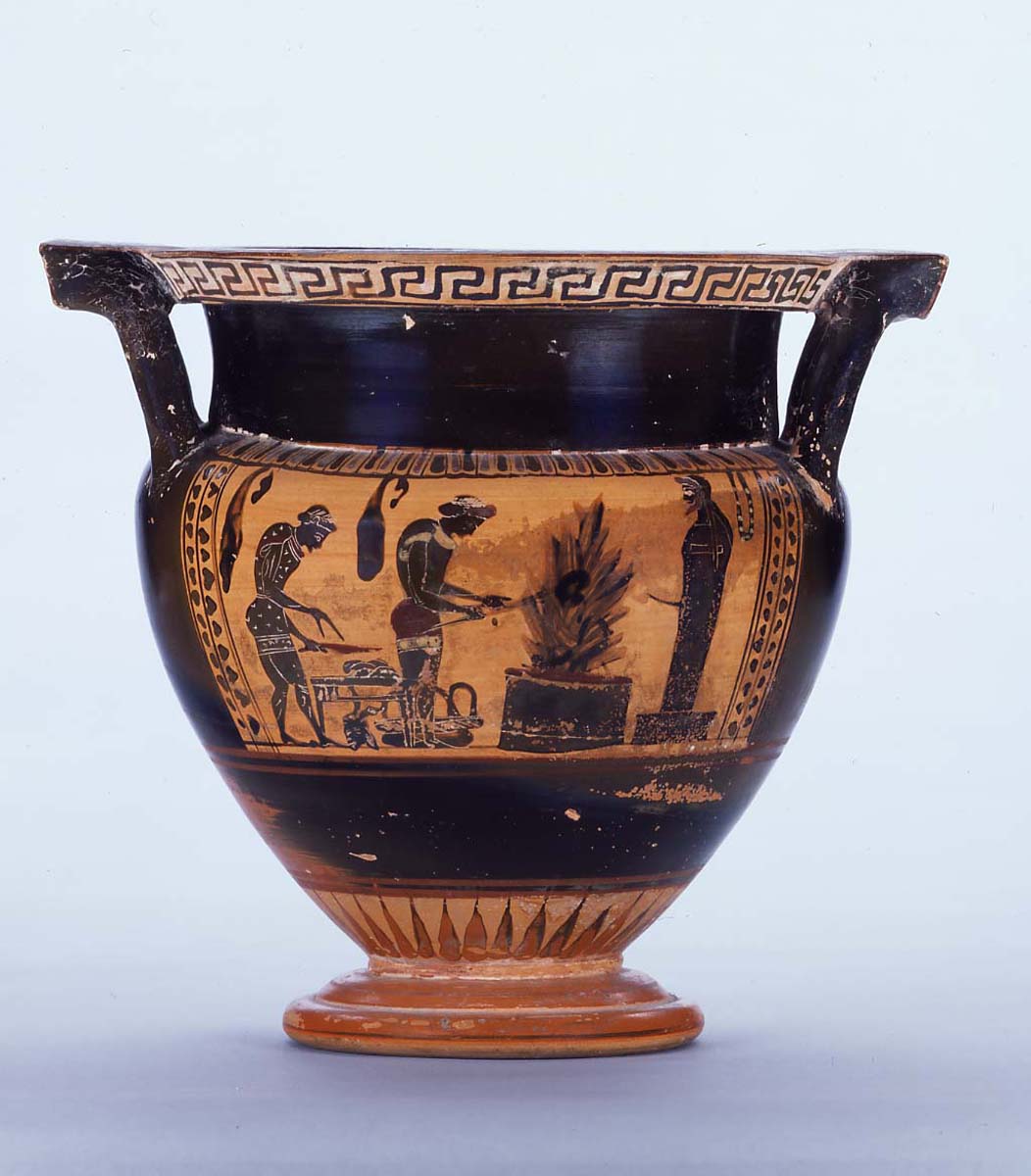
Schwarzfiguriger Terrakotta-Säulenkrater — Das schwarze vasenähnliche Tongefäß mit rundem Fuß zeigt schwarze Figuren auf einem rötlichen Bildfeld. Es stammt aus dem späten 5. Jahrhundert v. Chr. Der bauchige Vasenkörper ruht auf einem runden, gestuften, terrakottafarbenen Fuß. Auf den Vasenschultern sind die vertikal verlaufenden Henkel angebracht. Sie führen zum hervorspringenden Rand der Vasenöffnung. Das Bildfeld prangt auf dem Bauch des Gefäßes. Außer an seiner Unterseite ist es von Ornamentbändern gerahmt. Das Bild zeigt zwei Männer bei einem Feuer auf einem Altar, das vor einem Sockel mit Statue lodert. Die Statue befindet sich rechts auf der Darstellung. Ihr Körper ist säulenartig gestaltet. Gliedmaßen sind nicht erkennbar. Auf Höhe des Unterleibs ragt ein sich leicht nach oben krümmender Sporn heraus. Dieser scheint einen Phallus darzustellen. Deutlich erkennbar ist der Kopf der Statue. Die Figur trägt einen Helm und hat einen spitz zulaufenden Kinnbart. Links im Bildfeld beugt sich ein Mann leicht nach vorn zu einem etwa kniehohen Tisch. Er ist mit einem kurzen, enganliegenden Gewand bekleidet. In seiner Linken hält er ein Messer. Auf den Tisch sind Eingeweide gehäuft, darunter liegen ein Tierkopf und Skelettteile. Rechts neben den Tisch hält der zweite Mann an einem Spieß Fleisch in das hohe Feuer auf dem Altar. Am oberen Bildrand sind, gleichsam herabhängend, beutel- und schlauchförmige Organe positioniert. —— Black-Figure Terracotta Column-Krater — The black vase-like terracotta vessel with a round base depicts black figures as part of a scene against a reddish background. It dates from the late 5th century B.C. The round-bodied vase rests on a round, stepped, and terracotta-coloured base. The vertically running handles are attached to the shoulders of the vase. They lead to the protruding rim of the vase opening. The area occupied by the scene is emblazoned on the belly of the vase. Except for its underside, it is framed by ornamental bands. The picture shows two men at a fire on an altar blazing in front of a pedestal with a statue. The statue is depicted at the right end of the scene. Its body is columnar in shape and its limbs are not visible. At the level of the abdomen, a spur curves slightly upwards. This seems to represent a phallus. The head of the statue is clearly visible. The statue wears a helmet and has a pointed chin beard. At the left end of the scene, a man is bending slightly forward towards a table that is approximately knee height. He is dressed in a short, tight-fitting robe. In his left hand, he holds a knife. Entrails are heaped on the table, and an animal's head and skeletal parts lie underneath. To the right of the table, the second man is holding meat on a spit in the high fire on the altar. On the upper edge of the scene, hanging downwards, are pouch- and tube-shaped organs.  
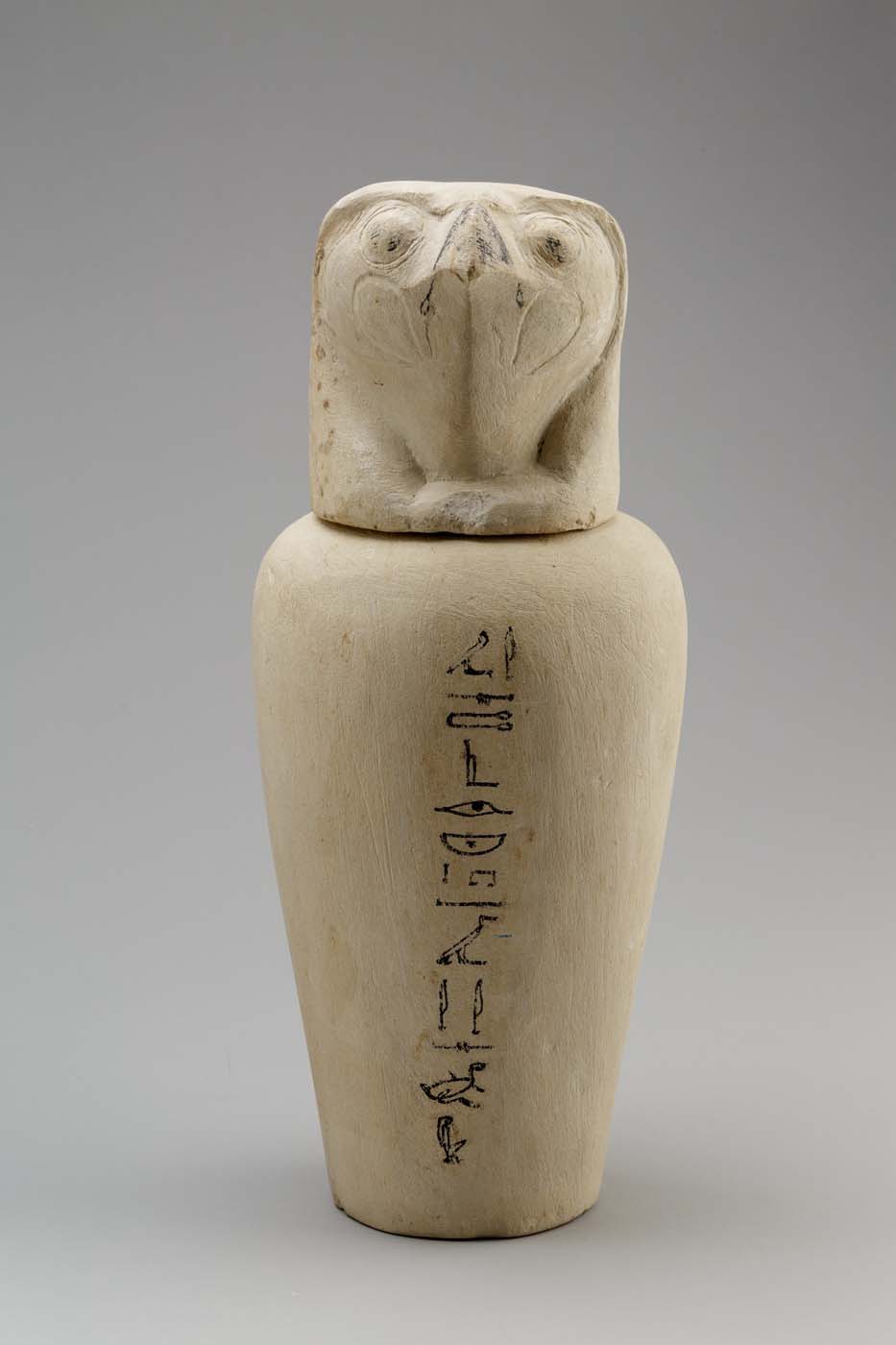
Kanopengefäß mit der Darstellung der Gottheit Qebehsenuef Vor grauem Hintergrund ist ein schlankes vasenähnliches Gefäß aus hellem Kalkstein mit Verschluss abgebildet. Auf seiner Vorderseite ist es mit Hieroglyphen in schwarz beschriftet. Das schmale Foto im Hochformat zeigt eine Kanope aus Ägypten. Sie ist im Zeitraum zwischen 818 und 525 vor Christus datiert. Als Kanopen, Kanopenkrüge oder auch Kanopenvasen werden in der Ägyptologie die Gefäße bezeichnet, in denen bei der Mumifizierung die Eingeweide separat vom Leichnam beigesetzt werden. Die auf dem Foto abgebildete Kanope misst 30,5 Zentimeter in der Höhe und hat einen Durchmesser von 12,8 Zentimetern. Das Gefäß verbreitert sich leicht von unten nach oben und bildet dort eine Rundung, ähnlich der Rundungen bei Schultervasen. In seiner Öffnung steckt ein steinener Falkenkopf wie ein Korken. Der Vogelkopf hat eine nahezu rechteckige Form, der kurze gekrümmte Schnabel zwischen den hervortretenden Augen ist schwarz gefasst. Der Falke steht für die Gottheit Qebehsenuef. Er war einer der vier Horus-Söhne und Kanopengötter, die di mumifizierten Eingeweide beschützen. Als seine Eltern galten der Gott Horus der Ältere und die Göttin Isis. Die Hieroglyphen verlaufen in einer senkrechten Linie von der Öffnung bis zum Fuß vorn am Gefäßkörper herab. Unter den Schriftzeichen finden sich einige, die an Zeichnungen von Tieren erinnern, wie ein ägyptischer Geier oder ein Entenküken. Weiteres Zeichen stellen zwei Schilfstängel nebeneinander und einen Türriegel dar. Die Oberfläche der Kanope ist mit schmalen Rillen und Kratzern überzogen, die als Spuren der Bearbeitung oder des Gebrauchs gedeutet werden können. — — Canopic Vessel Depicting the Deity Qebehsenuef A slender vase-like vessel made of light-coloured limestone with a stopper is depicted against a grey-coloured background. On its front, it is inscribed with hieroglyphics in black. The narrow photo in portrait format shows a canope from Egypt. It is dated between 818 and 525 BC. In Egyptology, canopic jars or canopic vases are the vessels in which the entrails are buried separately from the corpse during mummification. The canopic jar shown in the photo measures 30.5 centimetres in height and has a diameter of 12.8 centimetres. The vessel widens slightly from the bottom to the top, where it forms a curve similar to the curves of shoulder vases. A stone falcon's head is stuck in its opening like a cork. The bird's head has an almost rectangular shape, and the short, curved beak between the protruding eyes is set in black. The falcon represents the deity Qebehsenuef. He was one of the four sons of Horus and canopic gods protecting the mummified entrails. His parents were considered to be the god Horus the Elder and the goddess Isis. The hieroglyphs run down the body of the vessel in a vertical line from the opening to the foot at the front. Among the characters are some that resemble drawings of animals, such as an Egyptian vulture or a duckling. Other characters represent two reed stalks side by side and a door latch. The surface of the canopic is covered with narrow grooves and scratches, which can be interpreted as traces of workmanship or use.

Exploring the Inside of the Body
through Time and Space

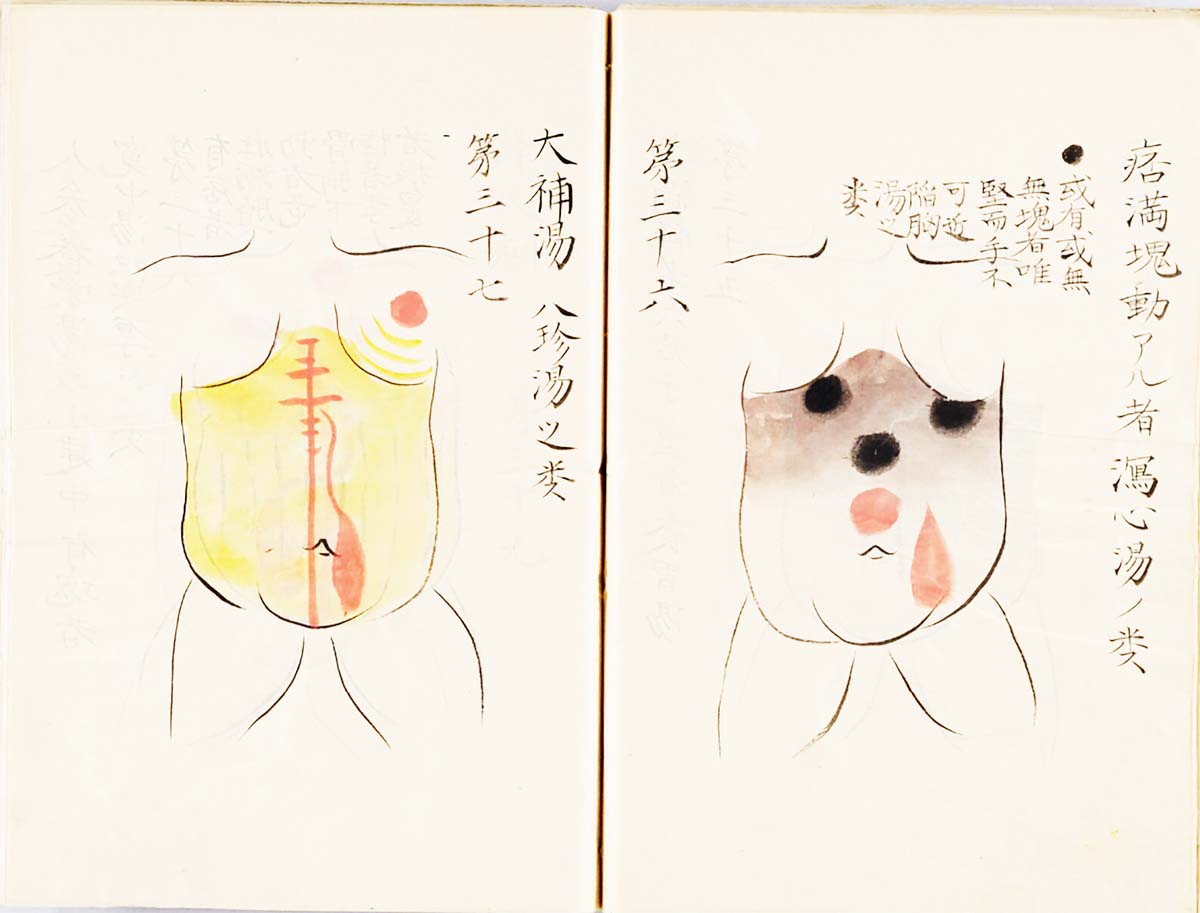
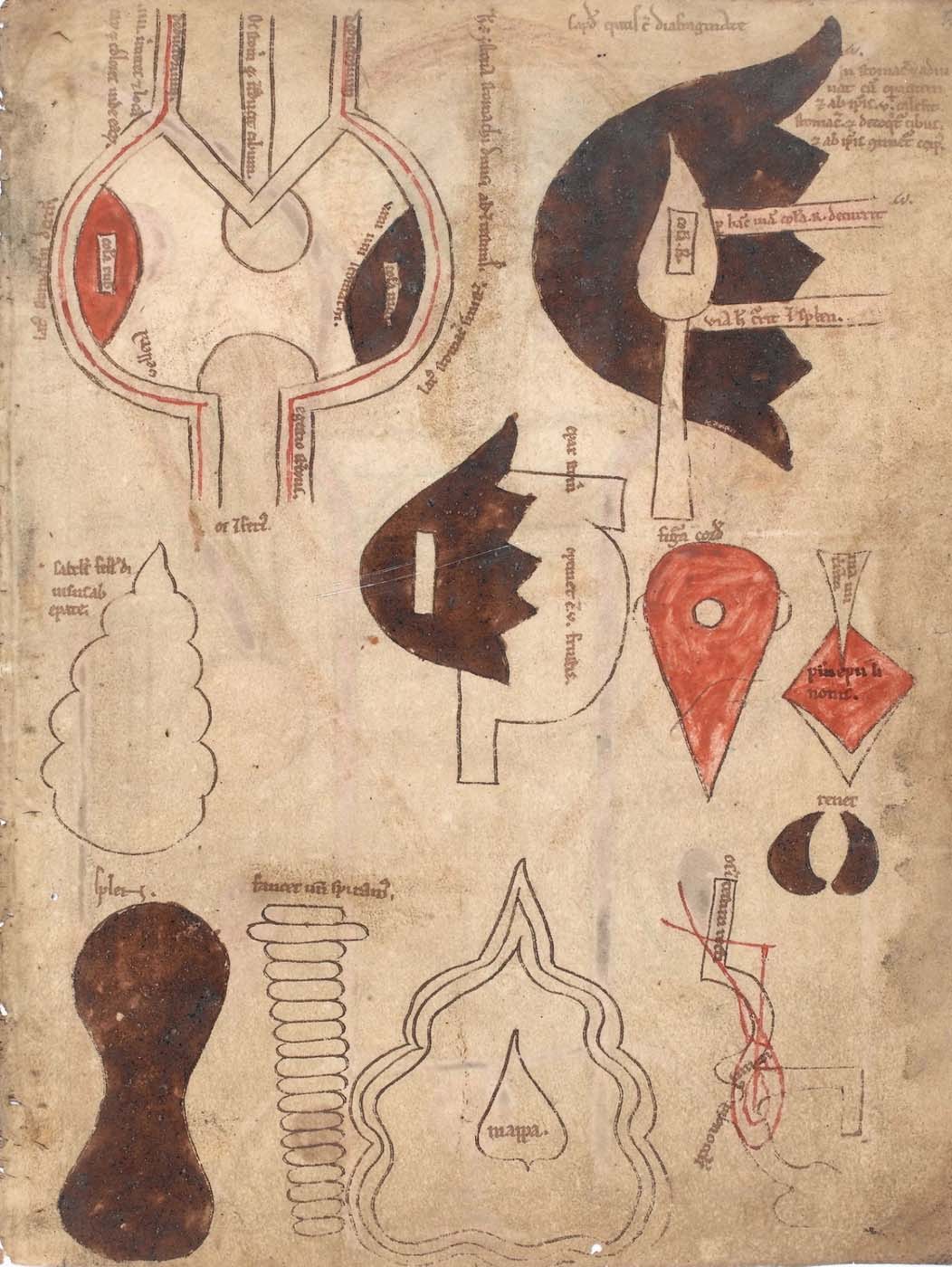
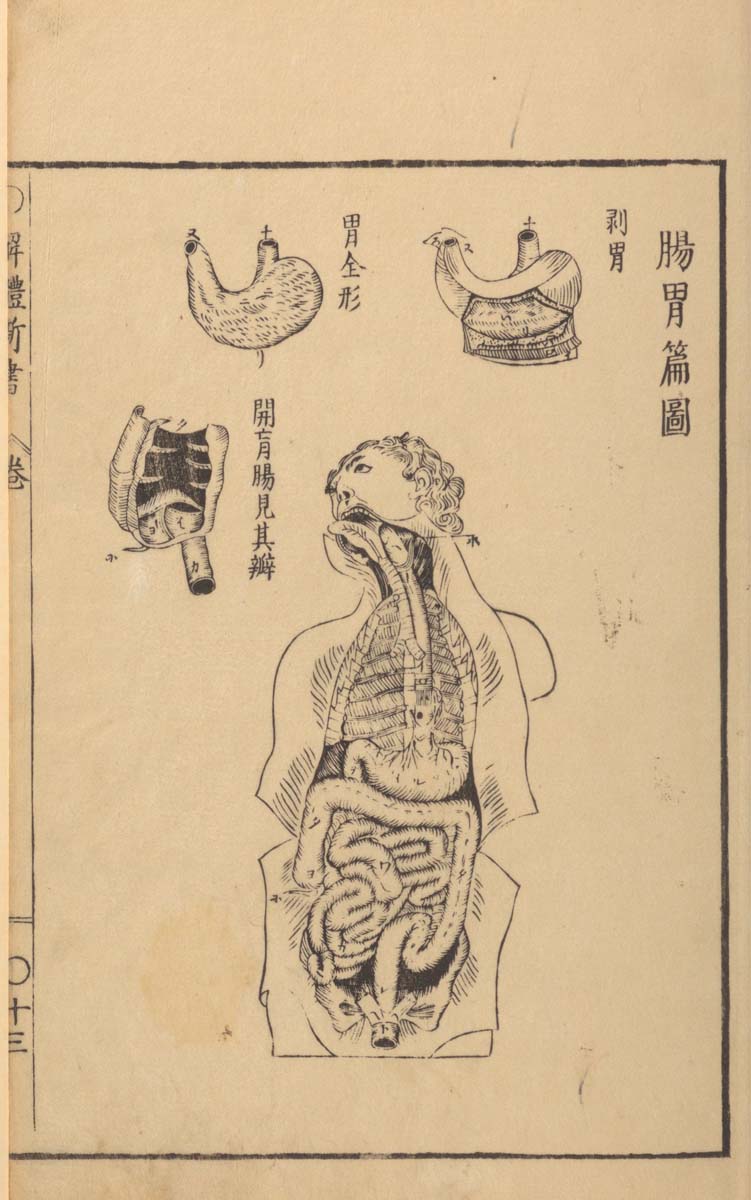
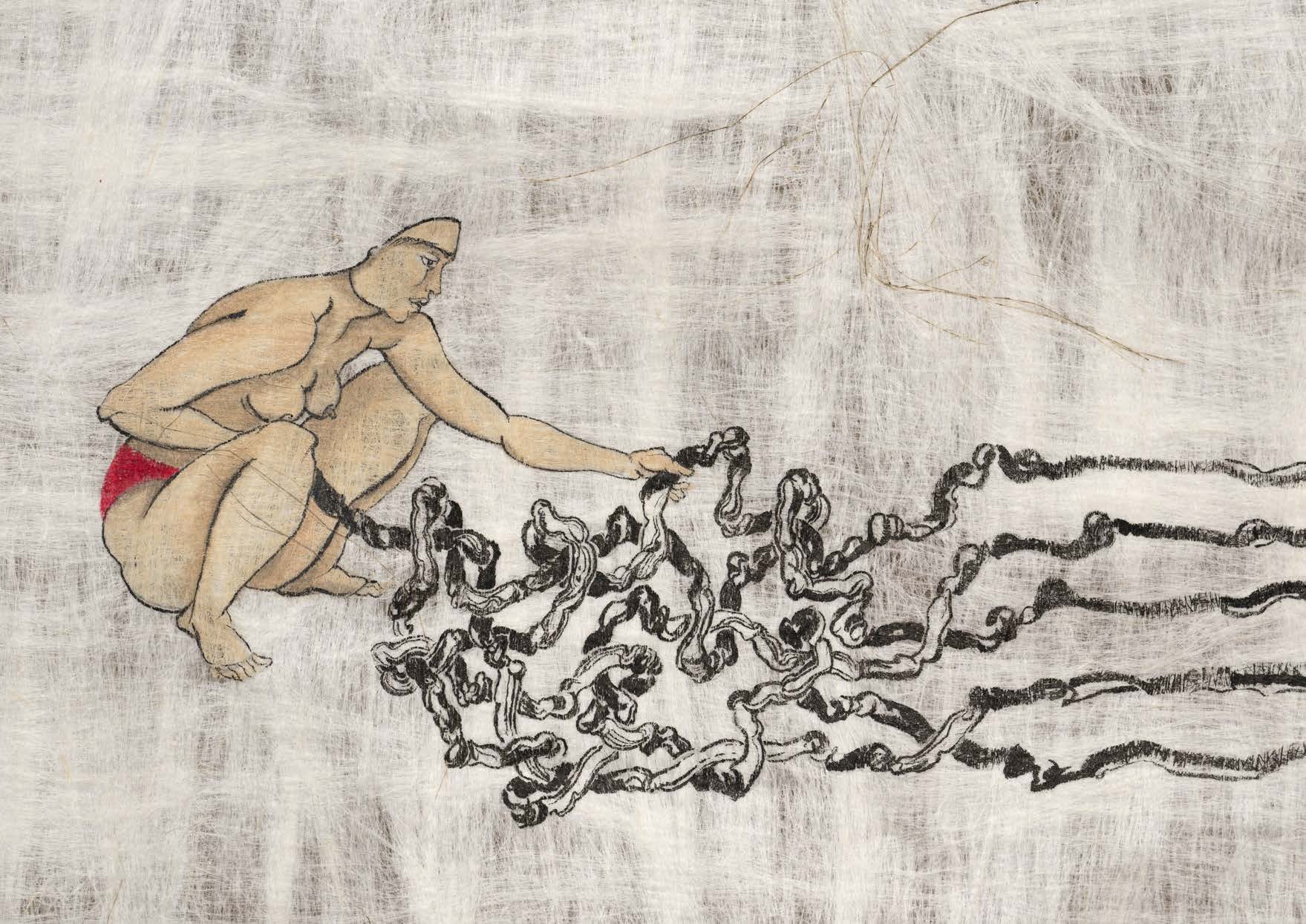
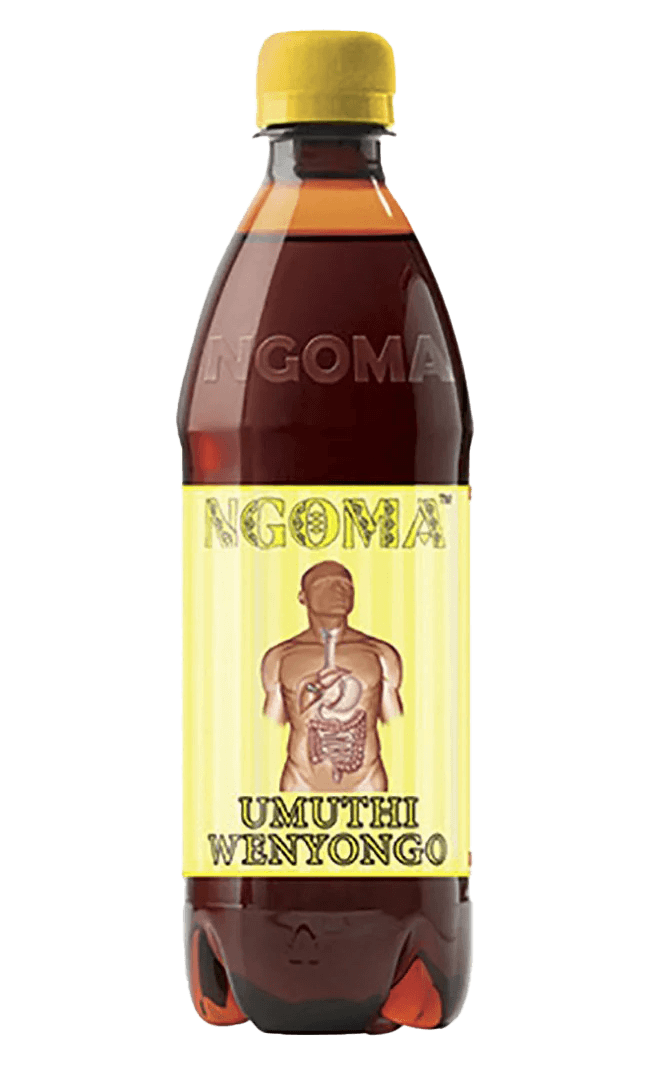
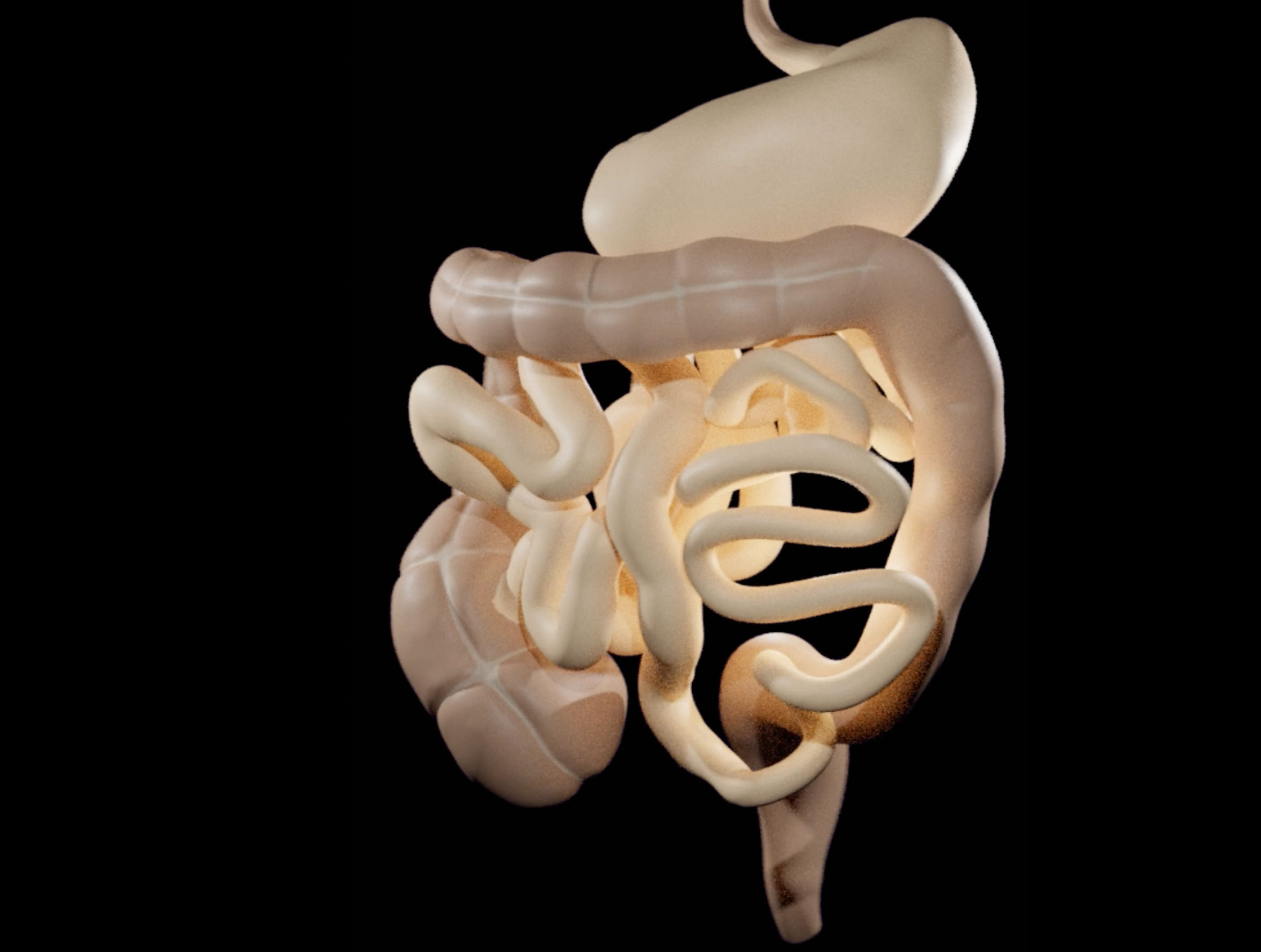
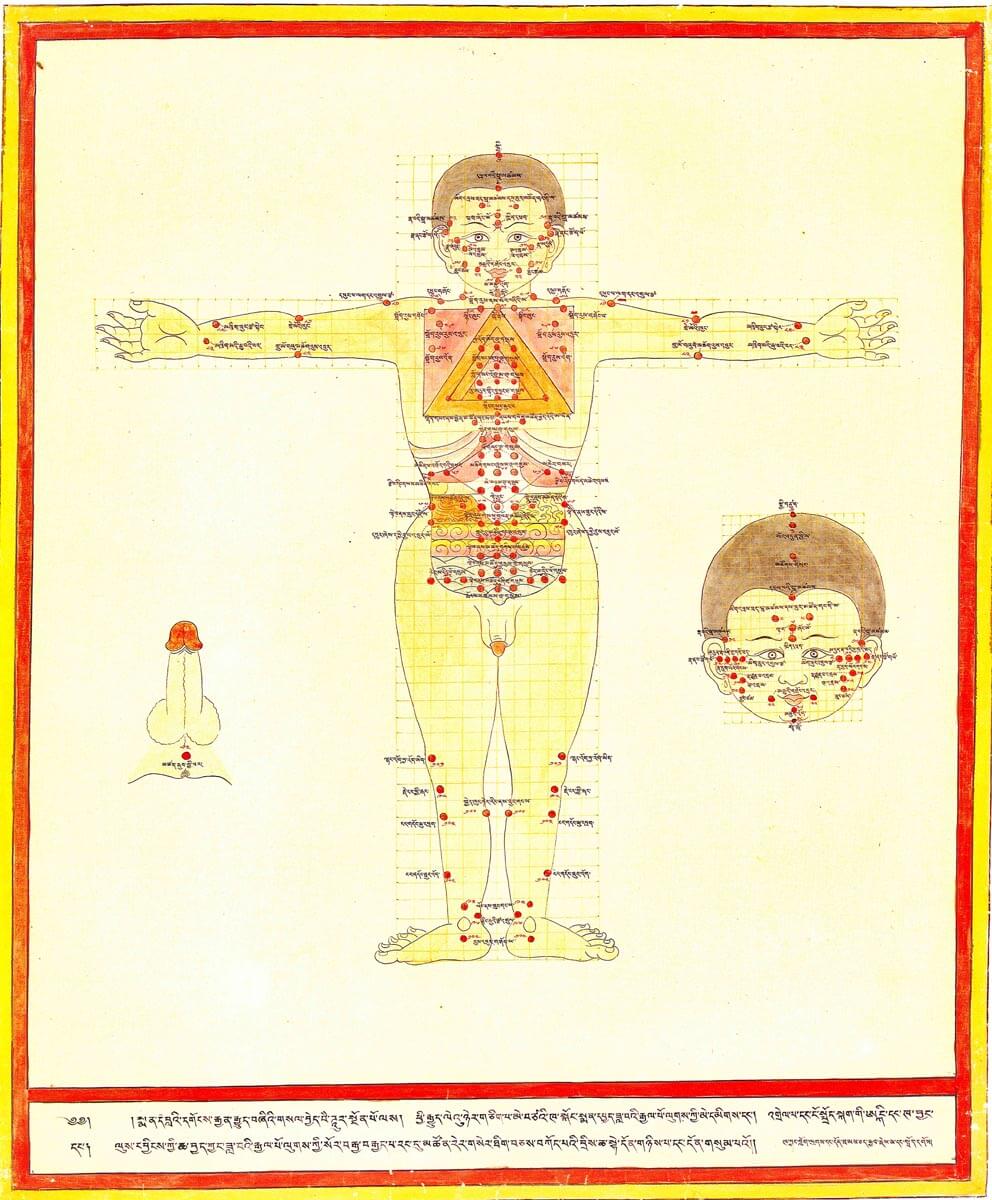
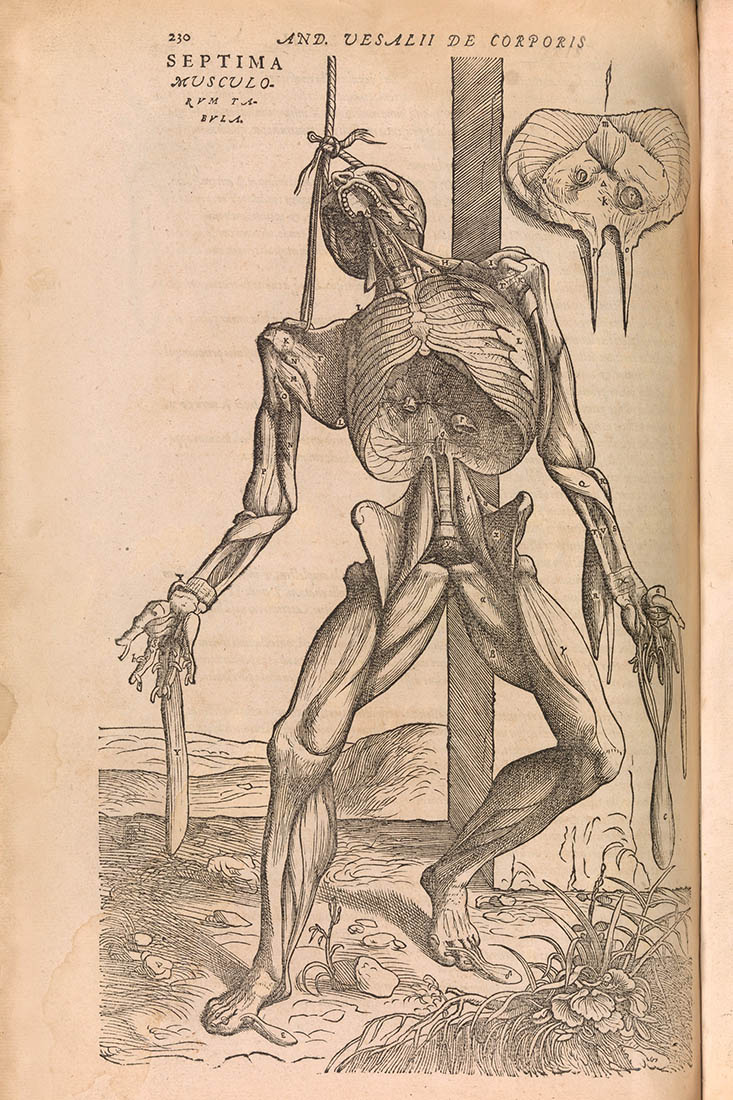
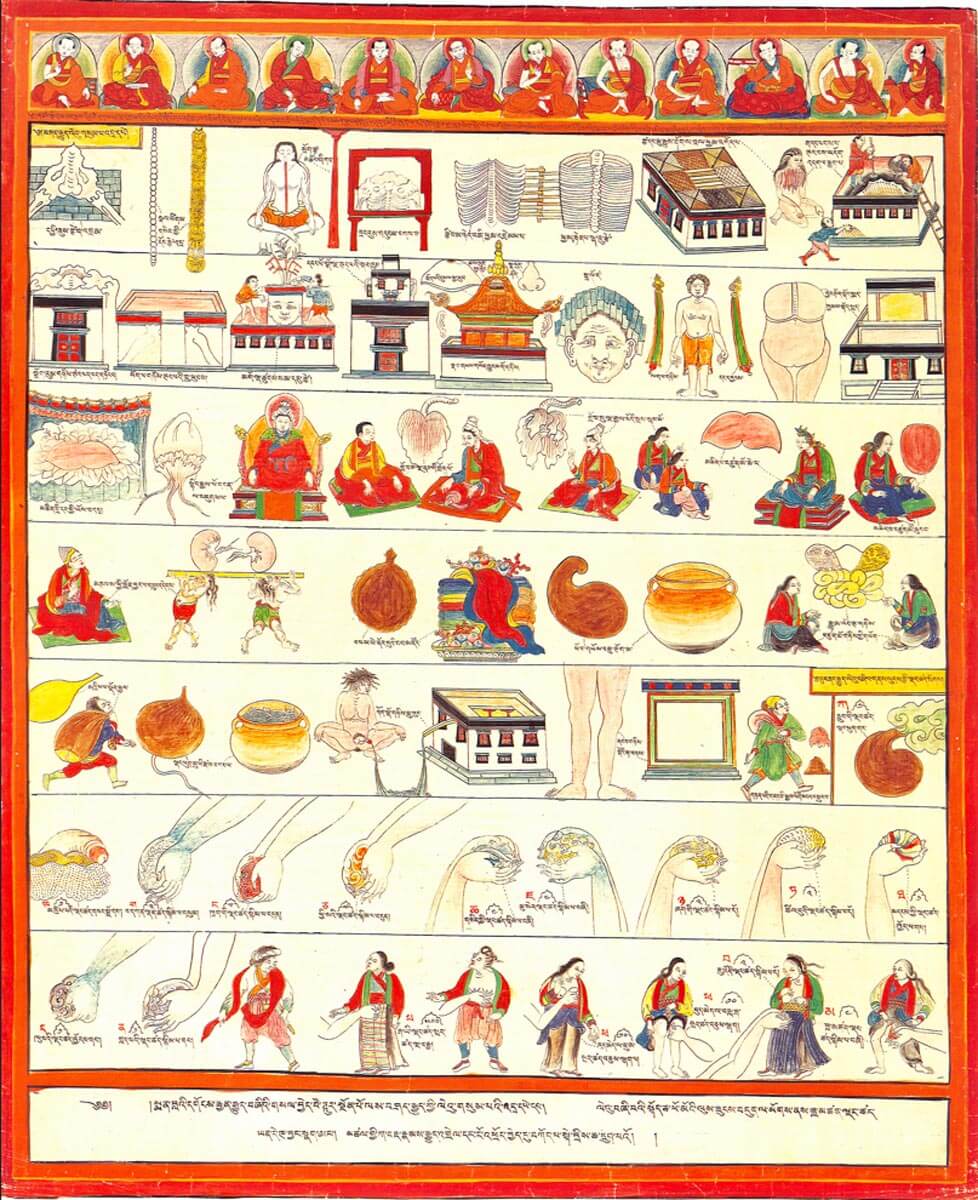
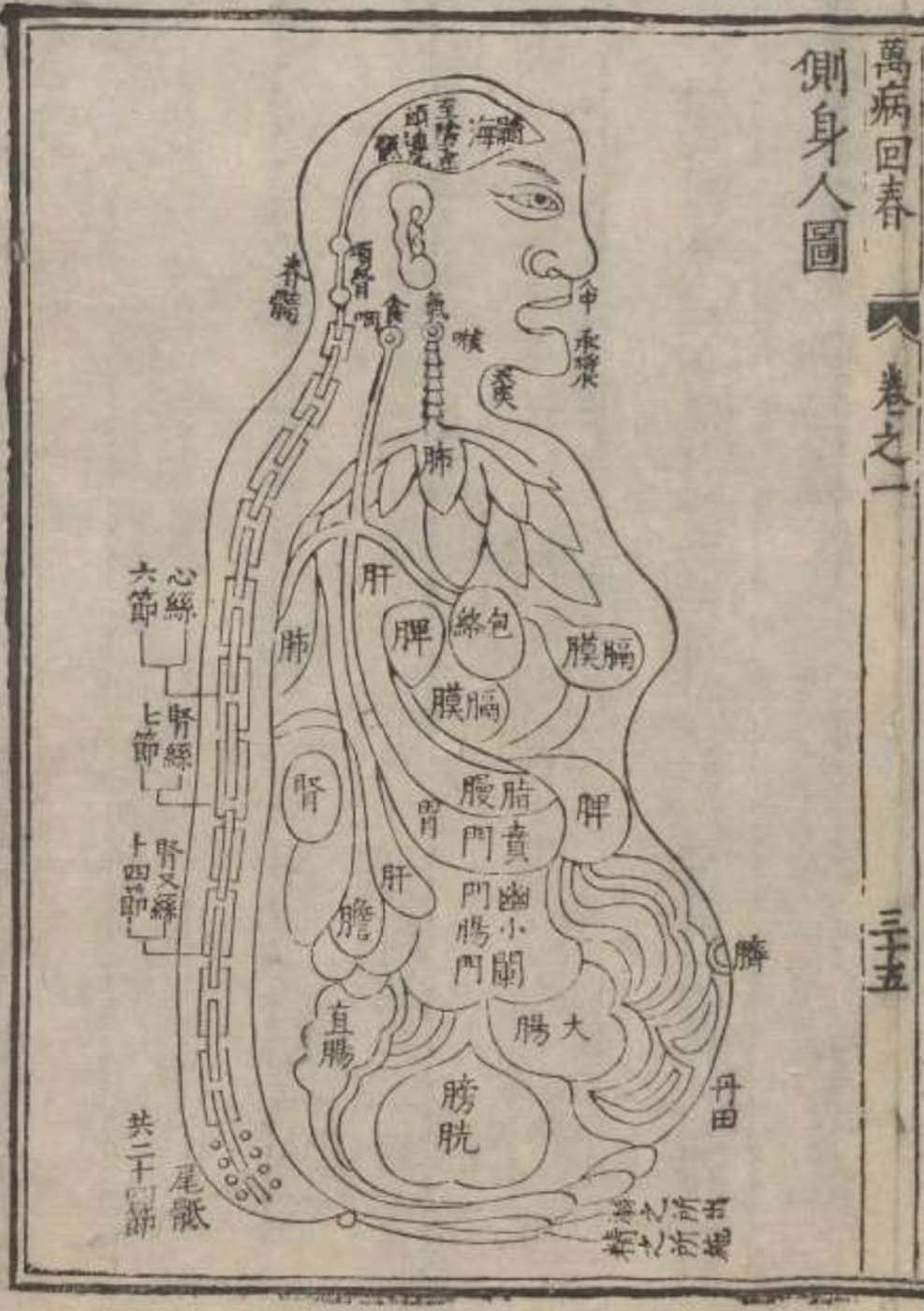
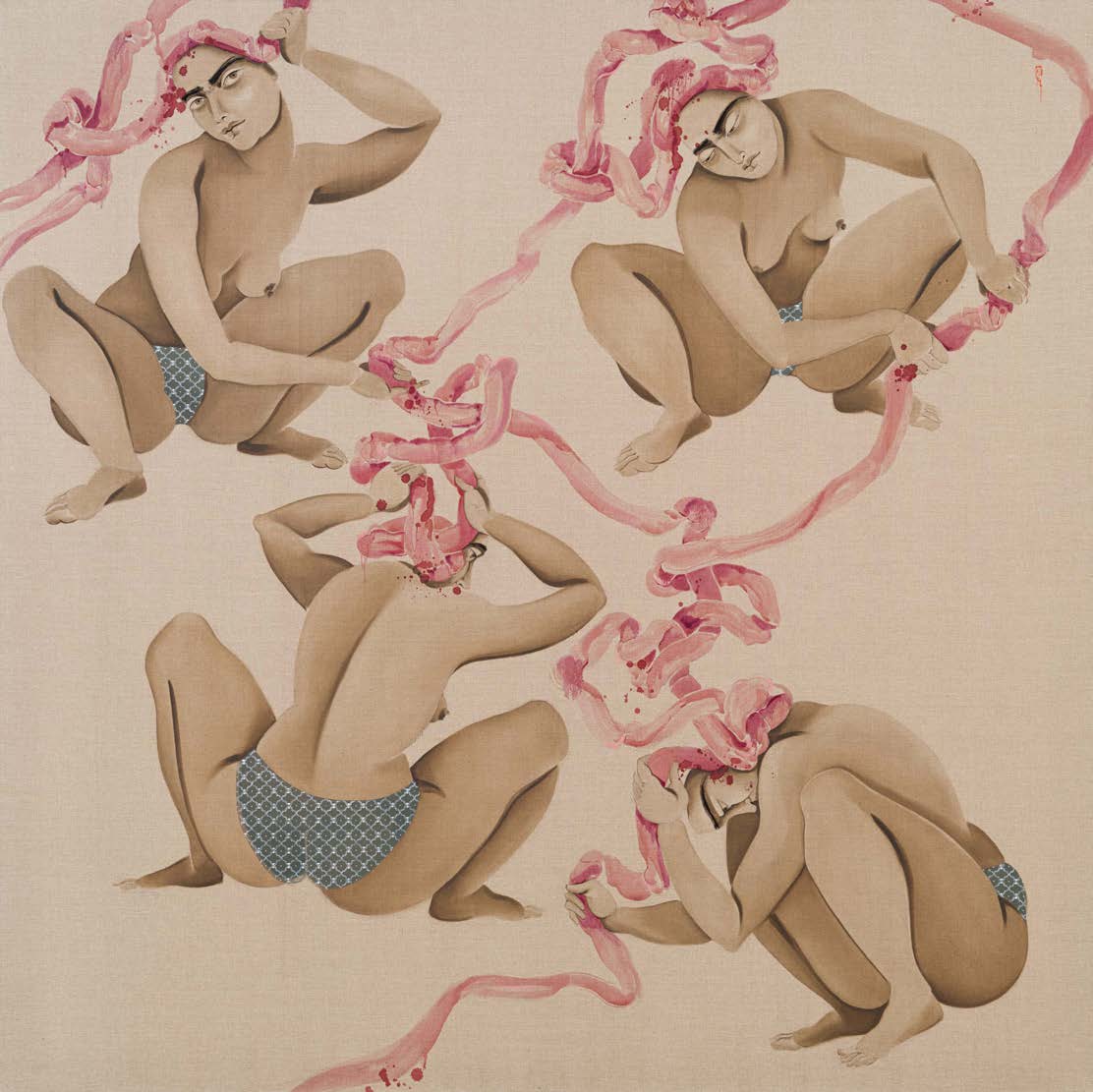
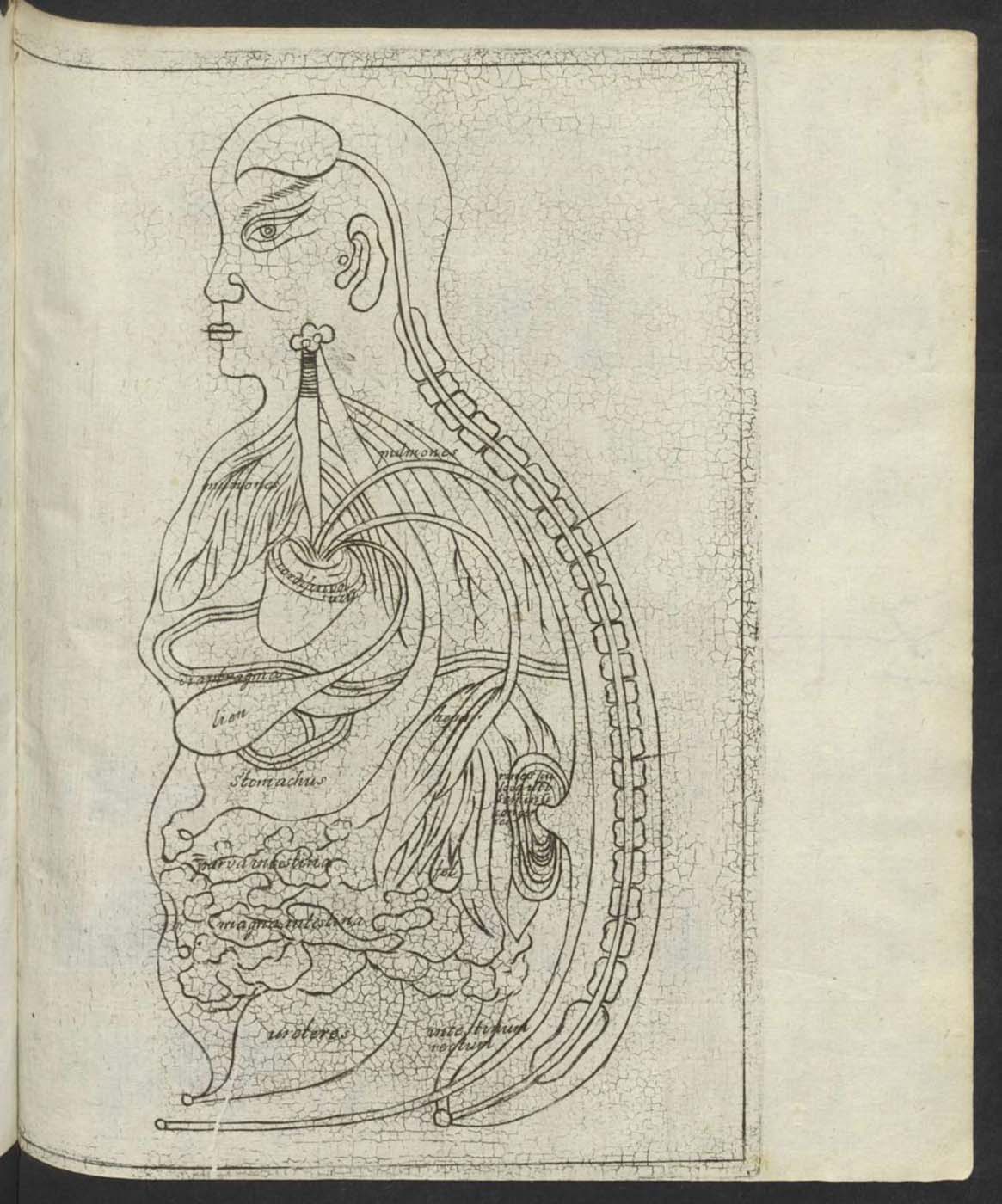
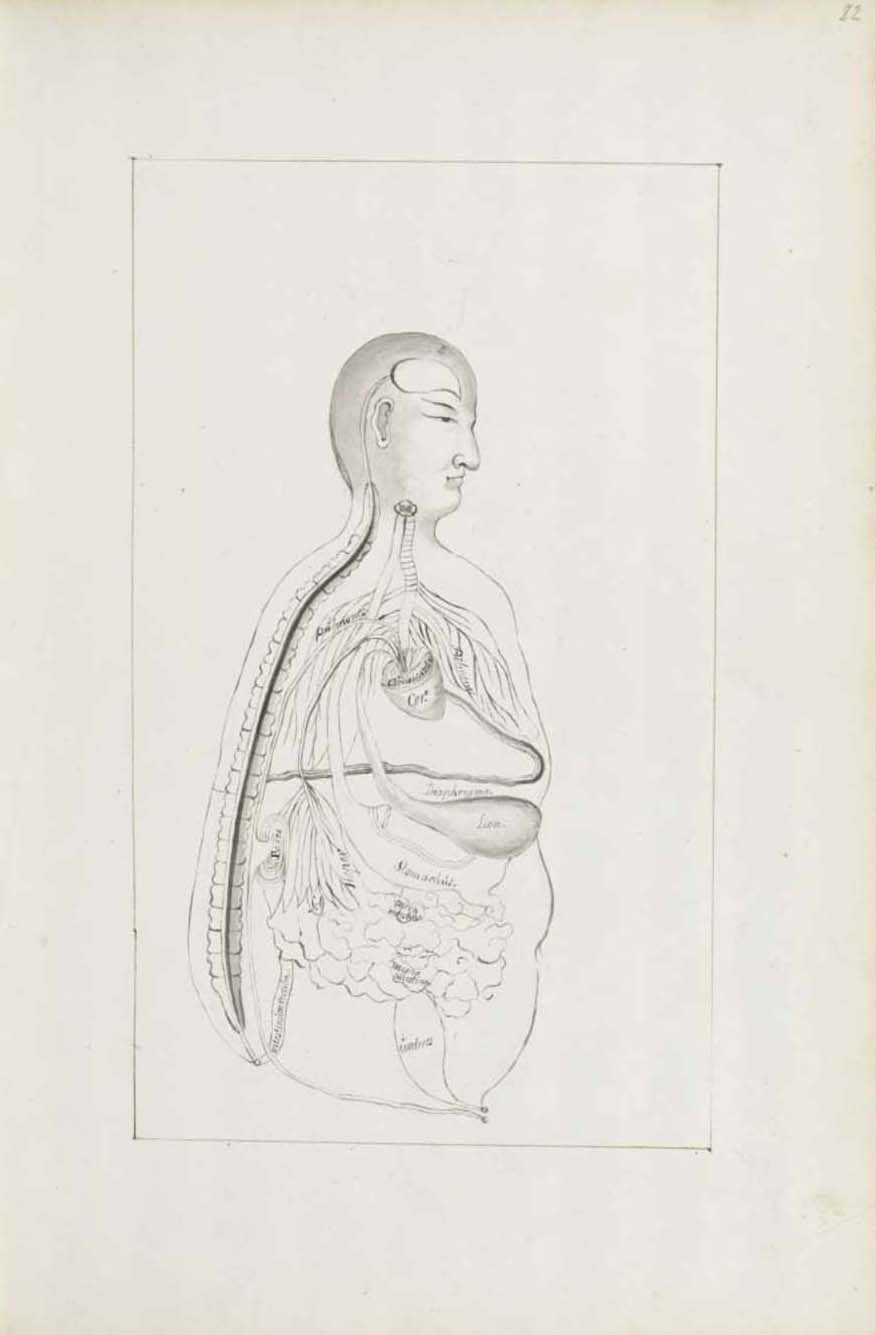
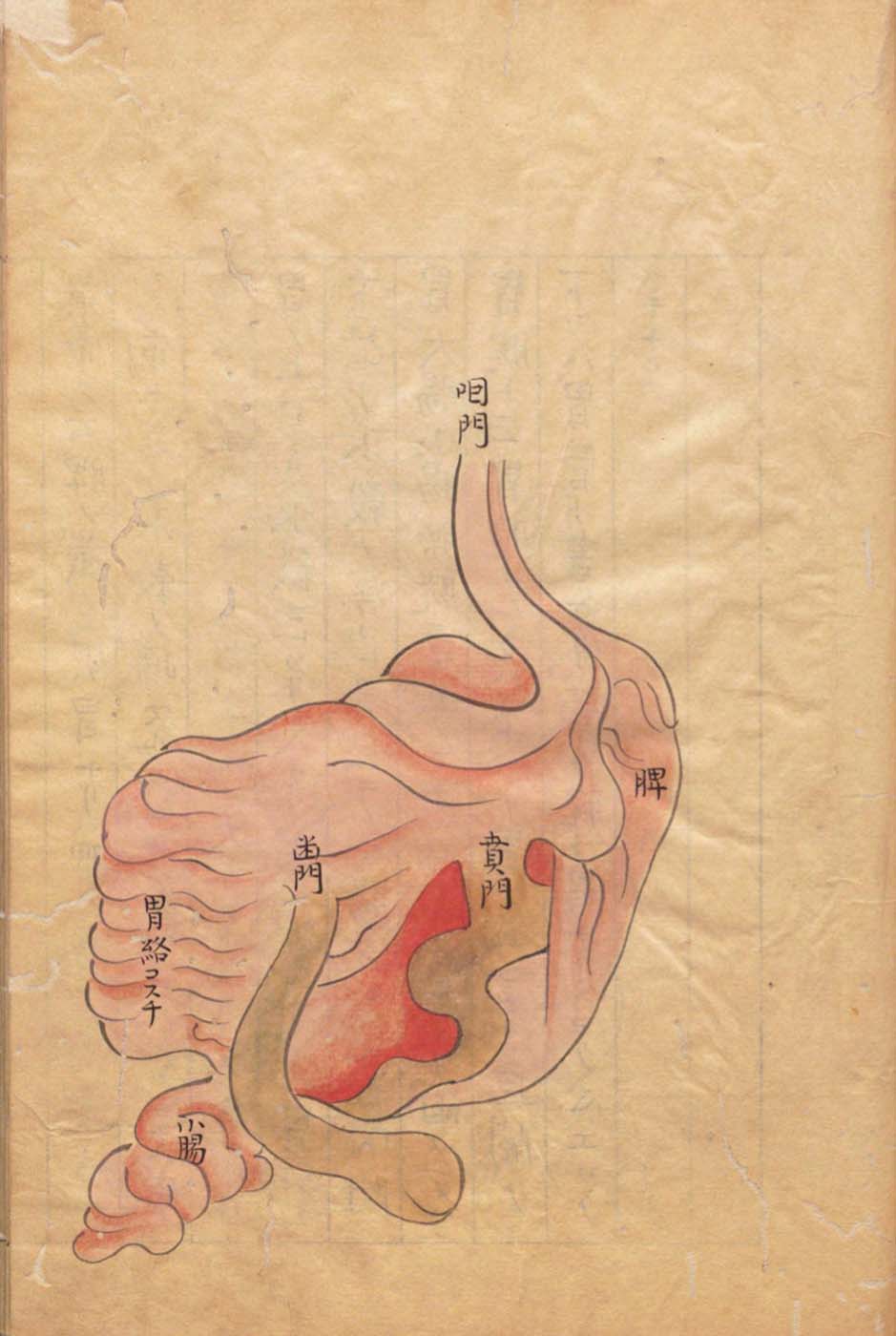
This is a comparative exhibition about the human body, and in particular about one body part, the ‘guts’. For these purposes, ‘guts’ refers to everything found inside the lower torso, the organs and parts traditionally linked to nutrition and digestion, but also endowed with emotional, ethical, and metaphysical significance, depending on the representation and narrative.

By offering access to culturally, socially, historically, and sensorially different experiential contexts, Comparative Guts allows the visitor a glimpse into the variety and richness of embodied self-definition, human imagination about our (as well as animal) bodies’ physiology and functioning, our embodied exchange with the external world, and the religious significance of the way we are ‘made’ as living creatures. This dive into difference is simultaneously an enlightening illustration of what is common and shared among living beings.

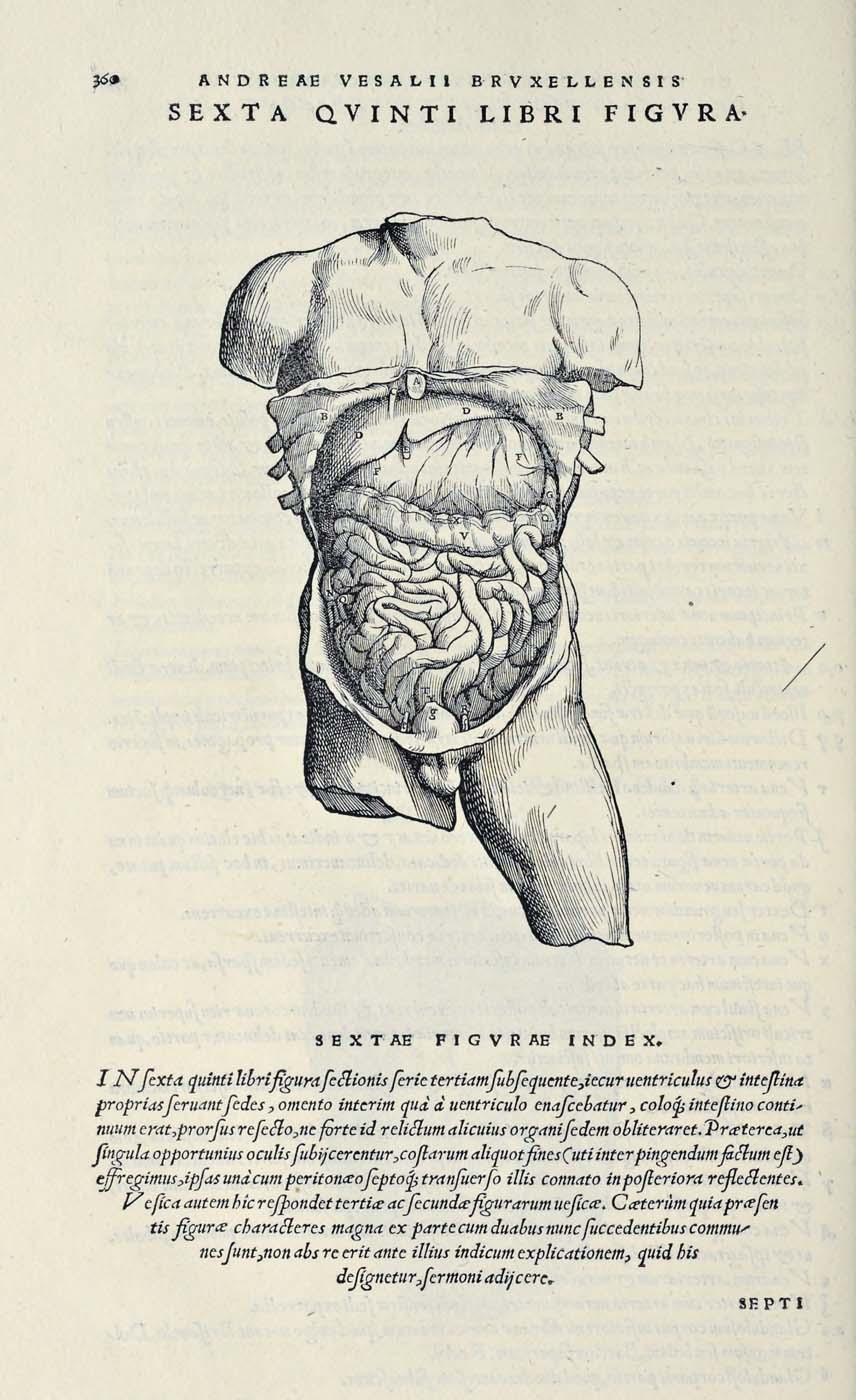
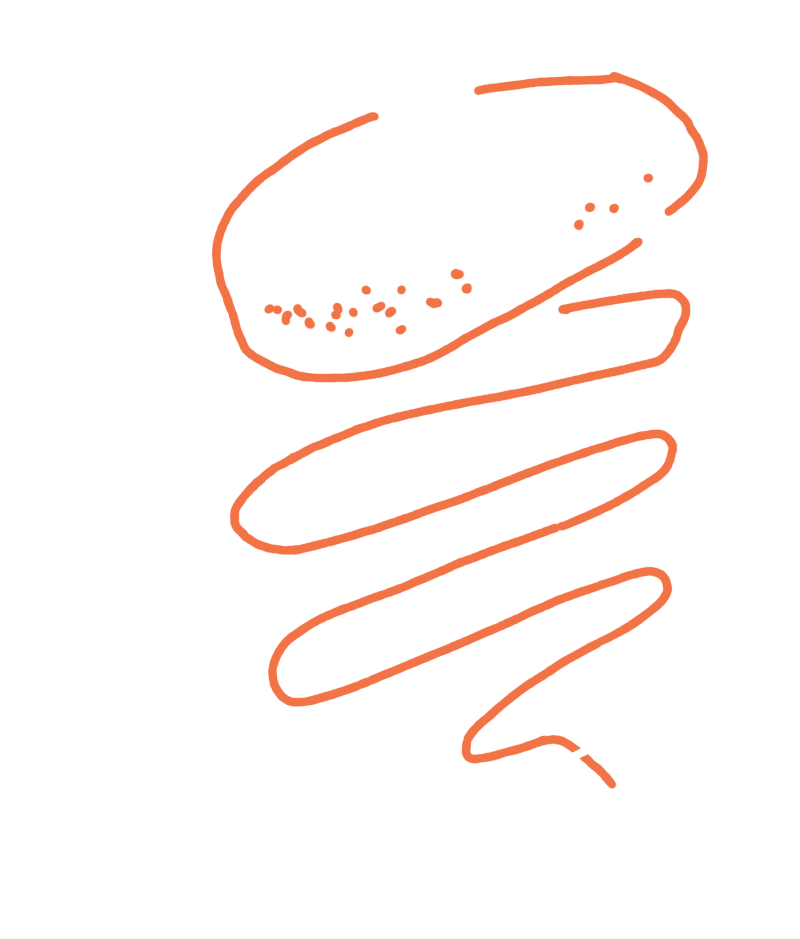
The ‘guts’ are treated here in as neutral and universal a fashion as possible: not necessarily as functional parts of an organism or as a medical item, but as realities experienced in various ways. The most basic distinction is the sensed, volumetric one: solids for the fleshy organs (such as those referred to in English as the liver and the stomach), coils for the intestines and other parts endowed with complexity, folds, and fluidity, and wholes for the guts understood as part of a coherent whole, be it continuous or assembled.